Beyond Clean Text: Evaluating Encoder and Decoder Robustness for Bangla Event Detection in Noisy Text
Abstract
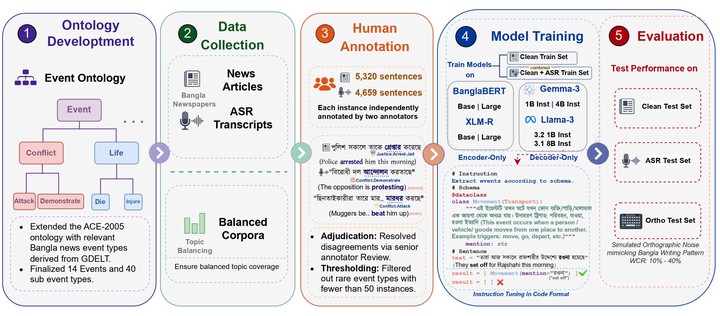
Event detection (ED) systems are typically evaluated on clean, curated text, leaving their robustness to real-world noise largely unexplored, particularly for low-resource languages such as Bangla. We introduce a generalized Bangla news event ontology and a benchmark comprising 9,979 annotated sentences across 40 event subtypes, spanning clean news text, real-world Automatic Speech Recognition (ASR) transcripts, and orthographically corrupted text. We systematically evaluate fine-tuned encoder-only models (BanglaBERT and XLM-R) alongside instruction-tuned decoder-only large language models (Llama 3 and Gemma 3). Our results reveal a clear architectural trade-off: encoder models achieve higher performance on clean text but degrade substantially under noise, whereas decoder-only LLMs are markedly more robust, particularly when event triggers are corrupted. We further show that embedding annotation guidelines during instruction tuning establishes a higher performance baseline on noisy text but yields inconsistent reductions in performance degradation across noisy conditions. Finally, model scaling consistently improves the robustness of decoder-only LLMs, while combined training on clean and noisy data serves as an effective regularization strategy that disproportionately benefits encoder architectures, significantly narrowing the robustness gap.
Tanvir Ahmed Sijan
Prospective PhD Applicant
My research interests lie at the intersection of NLP and AI safety, focusing on human-AI alignment through human-centered evaluation, alignment methods, and LLM interpretability to develop safer and more trustworthy language models.